
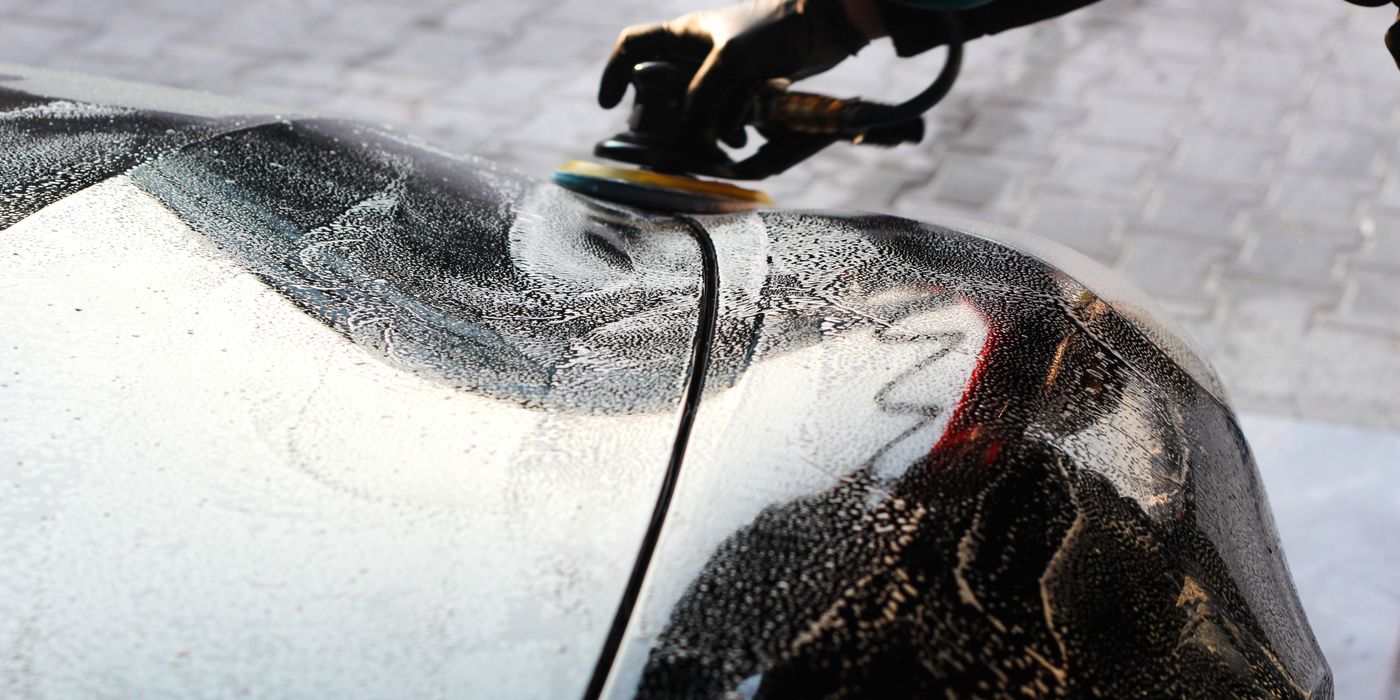
It usually starts the same way. You washed the car, it looks fine, and then you run a hand across the hood and it feels like fine sandpaper. Somebody nearby was spraying — a fence, a house, a parking lot restripe, a bridge — and the wind carried it to you.
Two things matter now, and most articles only cover the first. One is how it comes off. The other is who should be paying for it, because in most overspray cases it should not be you.
What overspray actually is
Atomized paint droplets travel on the wind, land on your car, flash off their solvent, and cure in place as thousands of individual hardened specks. That's why the visual is so strange: from six feet away the paint looks normal, because the specks are tiny and often the same tone as everything else. Your fingertips find it long before your eyes do.
It's almost always worse on horizontal panels — hood, roof, trunk — and heaviest on the side of the car that faced the source. That directional pattern is one of the ways we confirm it's overspray and not general fallout.
The one question that determines everything
Not how thick it is. What kind of paint it was.
- Water-based and oil-based paints — house paint, fence stain, most architectural coatings — tend to sit on top of your clear coat as a discrete layer. These are usually removable.
- Urethanes — automotive refinish, industrial coatings, some road marking paint — tend to partially fuse into the clear coat rather than resting on it. These are the ones that turn into a refinish job.
The question isn't how much overspray you have. It's whether it's sitting on your clear coat or has become part of it.
This is why an honest assessment matters more than a quote over the phone. We need to see it, feel it, and often test a small area before anyone can tell you truthfully whether this is a detailing job or a body shop job.
Will it wash off, or eventually weather away?
No, and no. It cured chemically onto your paint — it isn't dirt and washing has no mechanism to remove it. Waiting is worse than useless: the longer it sits through Valley heat, the more thoroughly it bonds, and biological fallout landing on top of a rough surface has more to grip.
Can it just be buffed out?
This is the most common misunderstanding, and it's worth being precise about. Overspray removal is fundamentally a mechanical lift — you're shearing discrete particles off the surface. Polishing is an abrasive levelling process — you're removing clear coat until the surrounding surface is level with the bottom of a defect.
Using a polisher as your primary overspray tool means grinding thousands of hard specks across your paint and spending clear coat you can never get back. Correction has a place in this work, but it comes after the contamination is off, to clean up any marring — not instead of removal.
Why clay bars and acetone make it worse
Both are all over the internet as overspray fixes. Both cause damage in inexperienced hands.
Clay works by shearing contamination off, and the lubricant is what carries the sheared particle away from the surface. Under-lubricated clay drags every particle it just removed across your paint. On a lightly contaminated car that's a haze you can polish out. On a heavily oversprayed panel it's severe marring across the whole car.
Acetone doesn't distinguish between the paint you want gone and the clear coat you want kept. It will soften both. We've seen more permanent damage from a well-intentioned solvent than from the original overspray.
How it's actually removed
- Wash and chemical decontamination first, including an iron remover where there's industrial fallout mixed in.
- Mechanical lift with properly lubricated media, worked in small sections and inspected constantly.
- Machine polish only where needed, to remove marring and restore gloss.
- Wet sanding as a last resort before refinishing, governed by a paint thickness gauge rather than by feel.
- Refinish at a body shop when the overspray has fused deeper than the remaining clear coat can safely give.
Glass is the easy part — it tolerates a blade at a shallow angle with lubrication in a way paint never will. The hard part is textured plastic, rubber seals, and unpainted trim. You can't clay or sand a grained surface, so overspray that settled into the texture is sometimes permanent. If your car has heavy overspray on the trim, ask about that specifically before anyone starts, because it's often the limiting factor on the whole job.
Who should be paying for this?
Here's the part that's worth more than the removal advice. If someone else's work put paint on your car, this is generally their liability, not your problem to absorb.
There's a catch that catches almost everyone, though. Paint drift is commonly excluded from a standard general liability policy under the pollution exclusion. A painting contractor typically needs specific contractors pollution liability coverage to be covered for exactly this, and a great many don't carry it. One subrogation practitioner's estimate — treat it as experience rather than a study — is that the large majority of painting contractors lack the coverage that would actually respond to an overspray claim.
Practically, that means two routes. If the responsible party is identified and insured, their carrier should handle it. Otherwise this usually goes through your own comprehensive coverage as a non-fault claim, and your insurer may then pursue the contractor to recover. Confirm the specifics with your own carrier — coverage language varies and we're detailers, not adjusters.
What to do in the first 48 hours
- Photograph the contamination in raking light, with a timestamp, before anything touches the car.
- Photograph the source while it's still there — the scaffolding, the striping crew, the job site. Once they pack up, proving where it came from gets much harder.
- Don't scrub at it, and don't let anyone attack it with solvent.
- Get a written assessment describing severity and method.
- Notify your insurer promptly, even if you expect the contractor to pay. Subrogation depends on the claim existing.
Multiple vehicles hit at once
Overspray incidents are rarely limited to one car. Wind doesn't respect property lines, and reported cases have involved drift across several blocks affecting hundreds of vehicles from a single job. If you're a contractor, a property manager, or an HOA looking at a lot full of contaminated cars, that's work we do — on site, vehicle by vehicle, with written per-vehicle documentation your insurer will actually accept.
Whether it's one car in your driveway or forty in a lot, the first step is the same: let us look at it before anyone touches it. Call us and we'll tell you honestly whether it lifts off or whether you're looking at a refinish.

The Nor-Cal Crew
Mobile detailing, ceramic coating & paint correction · Sacramento, California