
You bought the car, or you quit, or you finally had enough. You shampooed the seats, hung an air freshener, ran an odor bomb, left the windows down for a week. It smelled fine for two days. Then it came back.
It came back because none of that reached where the odor lives. Smoke odor is not a smell sitting in the air — it's a physical residue bonded to surfaces, and some of those surfaces are ones you can't see.
Why smoke residue doesn't just fade
There's real research on this. Nicotine deposited on surfaces doesn't sit inert — it reacts with nitrous acid in ambient air to form new compounds, including tobacco-specific nitrosamines that weren't in the original smoke. The contamination chemically evolves after it lands.
It also stays put. Laboratory work on fabrics found nicotine still present at meaningful levels more than a year and a half after exposure ended. And material matters enormously: in one study cotton released roughly forty times more nicotine than polyester did. Translated to a car, that means cloth seats and carpet hold far more than leather or vinyl.
The researchers' own conclusion is the useful part — these compounds do not spontaneously disappear from surfaces, so they have to be actively removed. Airing the car out is not a strategy. (Fair caveat: those studies were done on fabrics and in homes, not vehicles. The chemistry carries over; the exact concentrations don't.)
The four places the odor actually lives
Almost every failed smoke treatment missed at least one of these.
- The cabin air filter. Saturated with tar and particulate, and it sits directly in the airflow path. This is the single most common reason the smell returns.
- The HVAC evaporator. It runs cold, condenses moisture, and collects residue in a housing you cannot reach without dedicated tooling. Odor re-releases every time it cycles.
- Foam — seat cores, carpet padding, the headliner backing. Absorbent, deep, and untouched by surface cleaning.
- The headliner itself. Smoke rises. It is usually the most contaminated panel in the car and the one people are most afraid to touch, because a badly cleaned headliner delaminates and sags.
If nobody replaced the cabin air filter, the car re-scents itself the first time you turn on the fan.
Does ozone treatment work?
Ozone is what the cheap treatments rely on, and it deserves a straight answer: it has real limitations and real hazards, and it is not a substitute for removal.
The EPA's position is unusually blunt. Inhaled ozone damages the lungs. At concentrations that don't exceed public health standards it has little potential to remove indoor air contaminants — to be broadly effective against biological pollutants, concentrations would have to run five to ten times above what public health standards allow. No federal agency has approved these devices for use in occupied spaces.
There's a less-known problem too. Ozone reacts with other chemicals present and can produce new irritants. The EPA cites an example where ozone reduced some carpet chemicals but generated a variety of aldehydes, and the total concentration of organic chemicals in the air went up rather than down. It's possible to make the air worse.
It also attacks your car. Ozone cleaves the double bonds in many elastomers, which is why natural rubber, nitrile, and SBR components embrittle and crack with exposure. Door and window seals, hoses, and some adhesives are all in that category. There's a nice irony here: EPDM resists ozone well, which is exactly why it gets used for weatherstripping — but plenty of other rubber in a car does not.
Worth being precise on the California angle, since it gets overstated: CARB requires indoor air cleaning devices sold here to be certified at no more than 0.050 ppm ozone, and recommends against ozone generators outside approved industrial use. That regulates consumer air cleaners — it does not make professional equipment illegal. Anyone telling you ozone generators are banned in California is oversimplifying.
What about hydroxyl generators?
Hydroxyl systems are what the restoration industry has been moving toward, and the trade association's position is that they're safe to use in occupied spaces when manufacturer guidance is followed. The practical advantage is that they can run during physical cleaning rather than requiring the space be sealed and vacated afterward.
One caveat that applies directly here: the same guidance warns about high oxidant concentrations in small, unventilated spaces — and a car cabin is precisely that. We'd also steer you away from anyone claiming hydroxyl generators emit no ozone whatsoever; that's contested within the industry and not settled.
Do vinegar, charcoal, and odor bombs work?
Charcoal and baking soda adsorb some airborne molecules and will take a mild edge off. They do nothing about residue bonded to a headliner or sitting in your evaporator. Vinegar swaps one smell for another for a day. Odor bombs and fogging products largely mask — even sources selling thermal fogging concede it controls odor more than it eliminates the source.
Enzyme cleaners are worth a specific note because they're often recommended for this and are mechanistically mismatched. Cleaning enzymes are mostly proteases and amylases, which break down proteins, fats, and starches. Smoke residue is tar, resins, and polycyclic aromatic compounds. Enzymes are excellent on pet odor, where the chemistry actually lines up. They are not the tool for smoke.
What actually works: removal first
Source removal, then gas-phase treatment for whatever remains. Never the reverse.
- Replace the cabin air filter. Non-negotiable, and it's the cheapest step in the process.
- Clean the evaporator and HVAC ducting with purpose-made equipment, and clear the condensate drain.
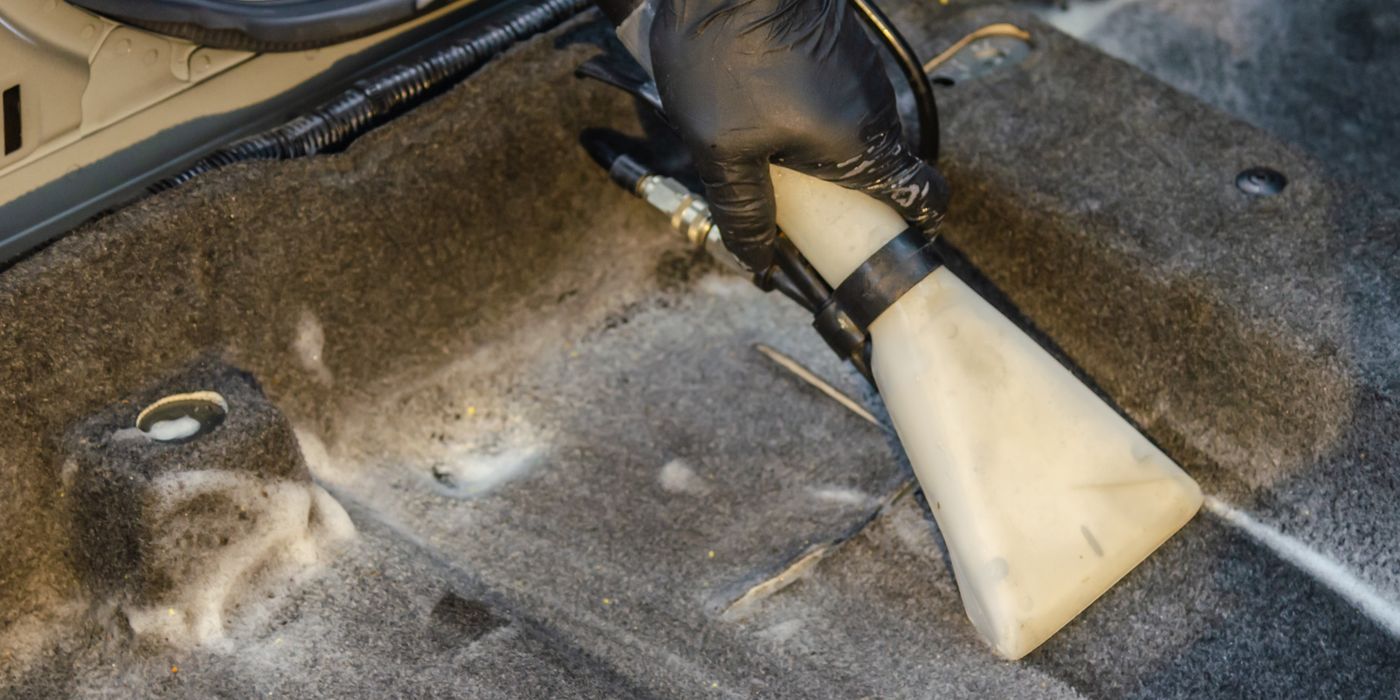
- Hot water extraction on carpet and cloth, worked to the depth of the contamination rather than the surface.
- Careful headliner treatment — low moisture, because saturating it delaminates the adhesive.
- Full hard-surface wipe-down including the areas people skip: the underside of the dash, pillar trim, the inside of the roof rails, seat belts and their retractors.
- Gas-phase treatment last, to address what's left after everything above.
One encouraging finding from the research: standard washing removes nicotine and related compounds from fabrics effectively. Anything that comes out of the car and goes in a machine — floor mats, removable covers — is the easy part of the job.
Is smoke smell in a car dangerous?
This is worth taking seriously without catastrophizing. The residue includes compounds identified as carcinogenic, it persists for a very long time, and it transfers to skin and clothing on contact. That matters most if children ride in the car, and it's the reason we treat a smoker's trade-in differently from a car that just needs a clean.
Wildfire smoke is a different problem
Relevant heading into a Northern California autumn. Wildfire contamination enters from outside over a relatively short window and is dominated by fine particulate and combustion compounds. There's no months-long chemical reservoir the way there is with tobacco.
In practice that means it responds much better and much faster: HEPA vacuuming, surface cleaning, and — again — a cabin filter replacement, because smoke particulate clogs one quickly. If your car smells like campfire after a smoke week and the airflow has dropped, start with the filter. We wrote separately about the ash on the outside of your car, which is a related but distinct problem.
Just bought a smoker's car?
Do it before you commit to living with it, not after six months of trying air fresheners. The residue is still transferring to everything in the meantime, and a full decontamination is dramatically easier before you've added your own upholstery, car seats, and belongings to the contaminated environment.
We do this work at your home or office, and we'll tell you honestly up front whether we expect a complete result or a significant improvement. Severe cases occasionally need a second pass, and vehicles where contamination reached deep into foam sometimes need components replaced rather than cleaned. You'll hear that from us before you book, not after.

The Nor-Cal Crew
Mobile detailing, ceramic coating & paint correction · Sacramento, California