
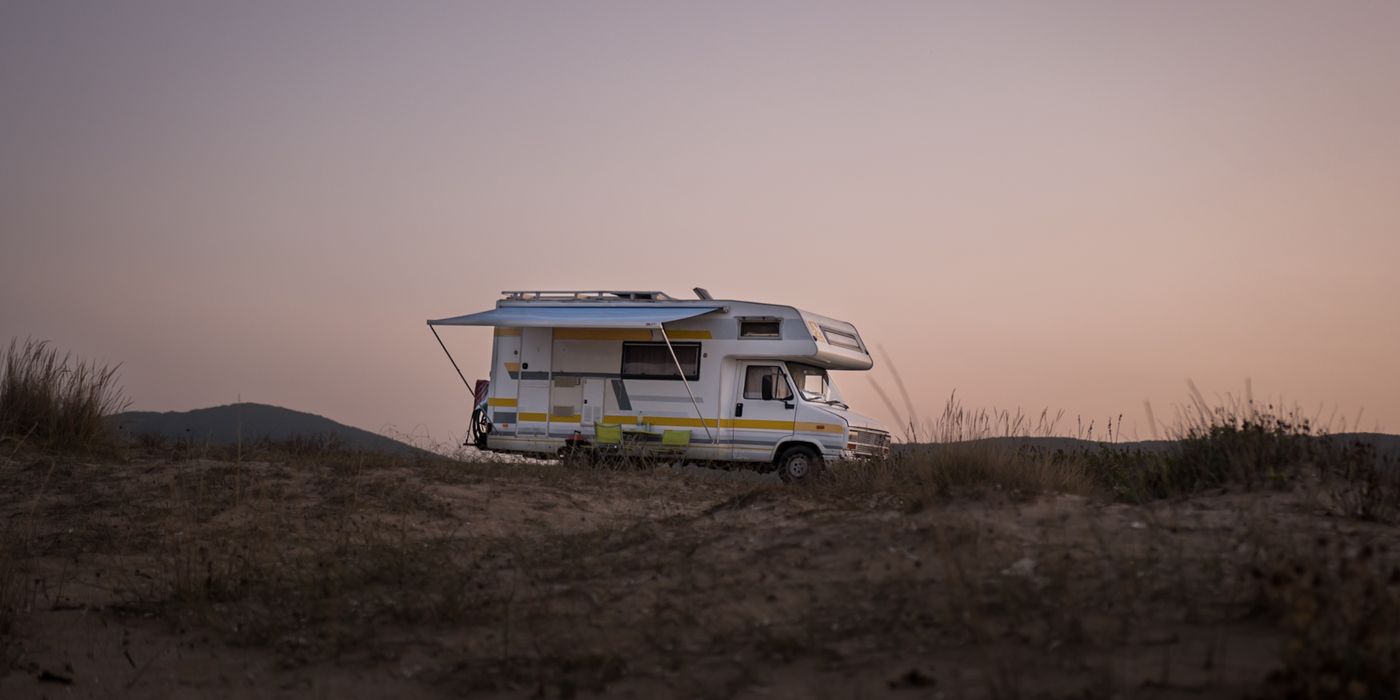
The case for coating a car is mostly about convenience: easier washing, better water behavior, less swirling over time. Good reasons, but nobody is claiming a car falls apart without one.
The case for coating an RV is different, and it is a materials argument rather than a lifestyle one. It comes down to what gelcoat is and what happens to it every time it gets restored.
Gelcoat has no clear coat, and that is the whole thing
Automotive paint is layered: color underneath, clear coat on top. The clear coat exists specifically to be sacrificed. It takes the UV, it takes the oxidation, and when we polish a car we remove a few microns of clear and the color is never touched.
Gelcoat is a pigmented polyester resin applied as the outer surface of the fiberglass laminate. The color and the surface are the same material. It contains UV stabilizers, and those deplete over time. When they are gone, the resin at the surface breaks down and releases loose pigment, which is the chalk that comes off on your hand.
Restoring it means removing that dead layer to reach sound material underneath. That works, and it works well. It also means that every restoration spends gelcoat that does not come back, and there is a finite amount of it, typically well under a millimeter on an RV sidewall.
You can restore oxidized gelcoat. You cannot do it indefinitely, and nothing puts back what a compounding pass removes.
Why a bare corrected sidewall starts over immediately
This is the part that surprises owners who have just paid for a full correction. Compounding removes the oxidized surface and exposes fresh gelcoat, which looks superb. It also exposes gelcoat whose UV stabilizers are being asked to start work on day one, in Sacramento sun, on a rig that lives outside.
Bare corrected gelcoat begins oxidizing again from that moment. A wax slows it for weeks. A polymer sealant slows it for months. Neither changes the underlying arithmetic, which is that you are on a schedule toward the next correction and every correction costs material.
A ceramic coating puts a UV-resistant layer above the gelcoat that takes that exposure instead. It is the closest thing gelcoat gets to a clear coat, and it is why we push this step on RVs harder than we push it on cars.
What it actually changes, week to week
- Black streaks from the roof rinse off instead of bonding into a porous surface. On a bare oxidized sidewall those streaks stain. On a coated one they are a rinse and a wipe.
- Washing a 34-foot coach stops being an all-day job. Contamination releases with far less contact, which matters enormously on a surface you have to reach from a ladder.
- Road film, bug splatter, and tree sap come off with pressure you can apply from ground level with an extension brush.
- The gloss holds through a season instead of dulling by August.
- The rig photographs like a maintained one, which matters if you ever sell it.
The honest limits
A coating does not repair oxidation, it locks in whatever surface it goes over. On a chalked sidewall it produces a durable chalky sidewall. The correction has to happen first, and on a badly oxidized rig that correction is the large majority of both the time and the cost.
It also does not do anything for the failure mode that actually kills RVs. Water intrusion through failing roof sealant is a separate maintenance item, and a beautifully coated coach with a leaking skylight is still on its way to delamination. We will always look at the roof, and if the roof needs work we will say so before quoting the sidewalls.
And it is not maintenance-free. A coated rig still needs washing, and it still needs an occasional decontamination, particularly along the lower sides where road film builds.
What a coated RV job actually involves
- A full wash and chemical decontamination, top down, including the roof so nothing runs down onto finished work later.
- An honest oxidation assessment panel by panel. Rigs are rarely uniform: the sun-facing side is often two stages worse than the shaded side, and the front cap is frequently painted rather than gelcoat and needs treating as automotive paint.
- Correction scaled to what we find. A single-stage correction where the oxidation is light to moderate, compound and refine where it has properly chalked.
- Masking and hand work at every decal edge and every surface transition. This is a real portion of the labor on a rig with full-body graphics.
- A panel wipe to remove all polishing residue, which on a surface this size is genuinely a step, not a formality.
- Coating application in sections, levelled within the flash window, working in shade with controlled panel temperature.
- A cure period during which the rig does not get washed or rained on, same rules as a car.
When it is the wrong purchase
If you are selling the rig this season, correct it and seal it. You will not recover the coating cost in the sale price and a good sealant photographs identically.
If the coach is stored under cover year round and the gelcoat is still healthy, a good sealant on a regular schedule is a defensible choice. The coating argument gets much stronger the more sun the rig sees.
And if the roof or the structure has real problems, that money belongs there first. We would rather send you to a repair shop and coat the rig next year than sell you a finish over a rig with water in the walls.
Send us a full-side photo in daylight and a close shot of a sun-facing panel, plus what happens when you wipe that panel with a dark cloth. That tells us which tier you are in, and whether coating is the right answer this year at all.

The Nor-Cal Crew
Mobile detailing, ceramic coating & paint correction · Sacramento, California