
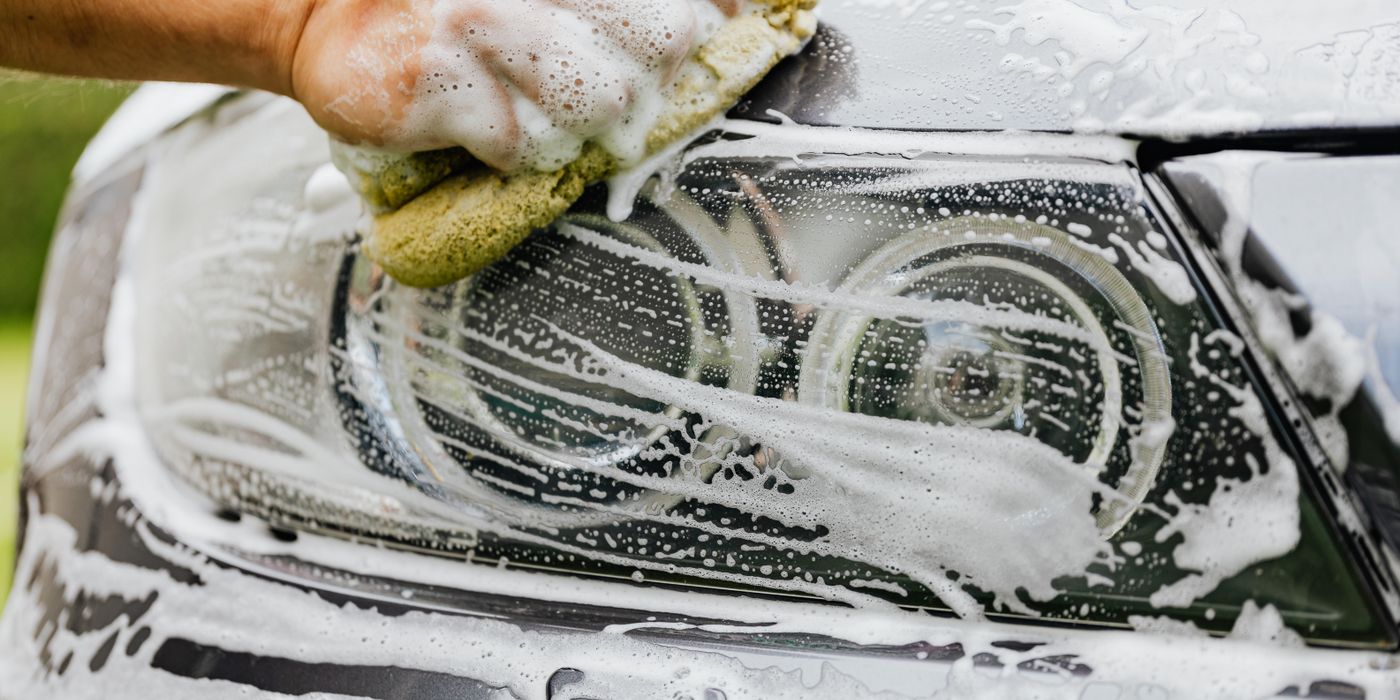
“My coating stopped working.” We hear it constantly, usually somewhere in year one or two. And most of the time, the coating is fine. It's buried — under mineral deposits, road film, and the fine dust that never really leaves the Central Valley. Here's how to read what your paint is telling you, and how to wash a coated car so it keeps behaving like one.
Hydrophobic is not self-cleaning
This is the misunderstanding underneath almost every disappointed coating owner. A ceramic coating doesn't stop dirt from landing on your car. It reduces how strongly that dirt can grip, so it releases easily and water carries it off. Dirt still lands. Bird droppings still land — and they're still acidic enough to etch if you bake them in July sun. What the coating buys you is time to remove them safely. Not immunity from having to.
Clogged, not failed
A coating produces its beading from a microscopically textured, low-energy surface. Fill that texture in and the water behavior disappears — even though the coating is still chemically there, still protecting the clear coat underneath. That's clogging, and it's the far more common diagnosis. The signs:
- Beads go from tight and round to flat and irregular, leaving trails behind them.
- Water sheets off in a lazy film instead of pulling into beads.
- The paint feels gritty or sandy after a wash, not glassy.
- Horizontal panels — hood, roof, trunk — look duller than the doors. They collect the most fallout and the most sprinkler spray.
The test is simple: do a full decontamination — an iron remover, a coating-safe chemical decon, gentle clay only where it's genuinely needed — and see if the beading comes back. In most cases it does, and the coating had years left in it. If hydrophobicity doesn't return after a proper decon, and water behaves exactly like it does on bare clear coat, that's actual failure.
Beading is a symptom you can read — it isn't the coating itself. A coating can still be protecting your paint while beading badly.
The wash that keeps a coating alive
- Pre-rinse first. Most swirl damage comes from dragging road grit across the paint, so remove everything you can before anything touches the surface.
- Two buckets, both with grit guards — one soap, one rinse. The mitt goes soap, panel, rinse bucket, soap. Never back into the soap dirty.
- pH-neutral shampoo. Not dish soap, not an all-purpose cleaner.
- Straight lines, not circles, and work top-down. Wheels and lower rockers last, with their own mitt and bucket.
- Dry with a plush drying towel or a blower. In Sacramento, letting hard water air-dry on the panel is how the clogging starts in the first place.
What genuinely degrades a coating
Two things, and they work differently. Chemically, the threat is strong alkalinity: the silicon-oxygen network a coating cures into is broken down by hydrolysis, and that reaction is dramatically accelerated by high pH. That's why harsh degreasers, traffic-film removers, and aggressive wheel cleaners are the products to keep off your paint — and it's worth knowing that touchless automatic washes get their cleaning power from exactly that kind of high-pH pre-soak.
Mechanically, the threat is abrasion. Any compounding or polishing removes coating — that's how we take one off deliberately. Clay is mildly abrasive too, so it's a targeted tool, not a routine step. And the spinning brushes in a friction tunnel carry the grit of every car ahead of you, which marks the coating and the clear coat underneath it.
Are silica toppers worth it?
Modestly, yes — for two honest reasons. A silica spray re-covers a surface that's worn or lightly clogged, restoring the gloss and water behavior you're missing. And it's genuinely sacrificial: contamination attacks the topper instead of the coating. What a topper does not do is add meaningful thickness or hardness, and we'd steer you away from the common claim that it recharges the coating underneath — there's no good evidence for that. One real caution: applying a topper over a clogged coating just masks the problem. Decontaminate first, then top.
How often?
Every two weeks is the honest answer for most coated cars here, and sooner if you've collected bird droppings, tree sap, bug splatter, or a week of sprinkler overspray. Between our hard water, summer irrigation, and Valley agricultural dust, coated cars in this region clog faster than they do in milder climates. A coating changes how you wash — faster, safer, far less product. It doesn't change whether you wash.
If your coating stopped beading and you're not sure which diagnosis you're looking at, that's exactly what our maintenance program is for. We'll decontaminate, inspect, and tell you honestly whether you need a top-up or a whole new install.

The Nor-Cal Crew
Mobile detailing, ceramic coating & paint correction · Sacramento, California