
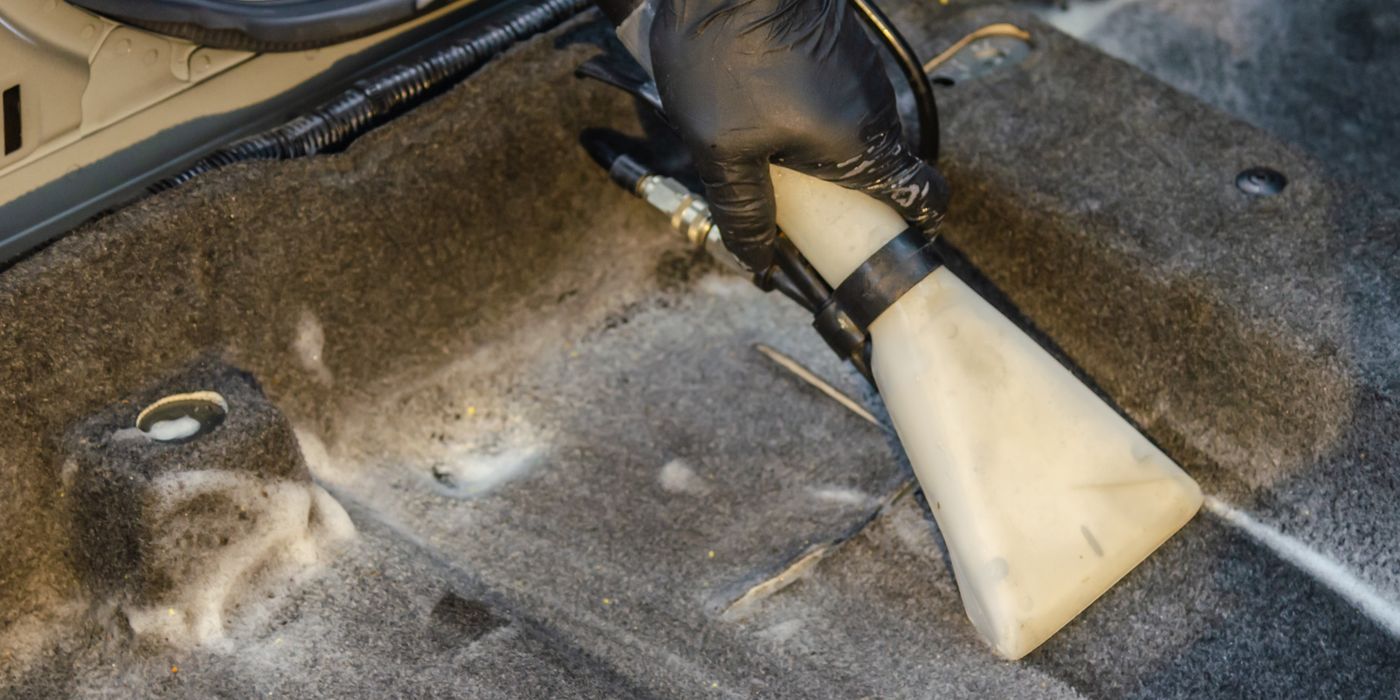
The tools that do a great job on a car cabin are the wrong tools inside a coach. A car interior is a sealed plastic and textile environment with a few square feet of carpet. An RV interior has vinyl plank or laminate flooring, residential-grade furniture, wood or wood-look cabinetry, window treatments, a shower, a kitchen sink, and a set of appliances, all mounted in a structure that flexes every mile.
Treat it like a big car and you will either underclean it or damage something. Here is what actually differs.
The flooring is not automotive carpet
Most modern coaches use vinyl plank or laminate through the main living area. Both are moisture-sensitive at the seams and at the edges, which is exactly where a wet extraction process wants to put water. Flooding an RV floor to clean it can swell a laminate core and lift a seam, and that damage does not reverse.
The correct approach is controlled moisture: appropriate cleaner, minimal water, immediate extraction or drying, and particular care along the slide-out tracks where the floor transitions. Slide seals are also one of the most common paths for water into a coach, so those tracks get inspected while we are down there.
The upholstery is residential furniture
Coach furniture is built more like a sofa than a car seat, which means thicker foam, more fabric, and far more capacity to hold water. Over-wetting a dinette cushion or a theater seat produces something that feels dry on the surface and is damp in the core for days, and damp foam in a closed coach is how a mildew smell starts.
Extraction has to be aggressive on recovery and conservative on application, and the coach has to be aired and dried properly afterward rather than closed up the same afternoon. On a job like this the drying plan matters as much as the cleaning.
The four places moisture hides
- Under and behind the mattress. A mattress sitting on a solid platform with no airflow condenses moisture underneath it, and the underside is where you find the first mildew in a coach that smells musty. Lift it and look.
- Inside the slide-out tracks and along the slide floor edges. Seals age, and a slide that has been operated in the rain brings water in with it.
- Under the sinks and behind the shower surround. Plumbing connections flex on the road. A slow drip inside a cabinet is invisible until the cabinet base swells.
- In the bottom of every storage compartment and wardrobe. Poor ventilation plus anything stored slightly damp equals a problem that spreads to everything around it.
A musty smell in a coach is almost never a job for an odor treatment on its own. It is a signal to find moisture. Treating the smell without finding the source buys you a few weeks.
In a car, a bad smell is usually something that spilled. In an RV, a bad smell is usually water that is still there.
Cabinetry, walls, and window treatments
Coach cabinetry is frequently a thin wood veneer or a printed laminate over a lightweight substrate, chosen for weight rather than durability. Aggressive cleaners and a lot of water will lift a veneer edge or dull a laminate finish permanently. A mild cleaner on a damp cloth, dried immediately, is the whole method.
Wall panels in most RVs are vinyl-faced luan rather than painted drywall. They clean well but they mark easily, and they do not tolerate scrubbing. Day and night shades, which are on nearly every coach built in the last fifteen years, are a delicate cellular fabric that collapses if you get it too wet, and they collect dust in every pleat.
The vents and the ducts
This is the step that gets skipped and it is the one that changes how a coach smells. Roof vent screens, the return air filters on the air conditioner, and the ducting all accumulate dust, and a rig that has been in dusty campgrounds accumulates a lot of it. Cleaning the vents and the AC filters does more for the interior air in a coach than any product you can spray.
What a full interior service covers
- Complete vacuum including under furniture, inside every cabinet and wardrobe, along the slide tracks, and in the storage bays.
- Hard floor cleaning with controlled moisture, and seam and edge inspection.
- Upholstery and mattress cleaning with proper extraction and a drying plan.
- Full wipe-down of cabinetry, walls, and trim with mild chemistry.
- Kitchen and bathroom deep clean, including the refrigerator, the range, and the shower surround.
- Windows, screens, day and night shades, and window tracks.
- Vent screens and air conditioner filter cleaning.
- Moisture inspection of the four hiding places above, with photos and an honest report.
- Odor treatment at the source where there is a source, rather than a masking product.
Time it either before the season, so the coach is ready to live in, or before storage, so nothing organic sits in a sealed box through the winter. Of those two, before storage is the one that prevents problems.
If your coach has a smell you cannot place, that is the call to make. Finding out whether it is a cleaning problem or a repair problem is the first half of the job, and it is the half that decides everything after it.

The Nor-Cal Crew
Mobile detailing, ceramic coating & paint correction · Sacramento, California