
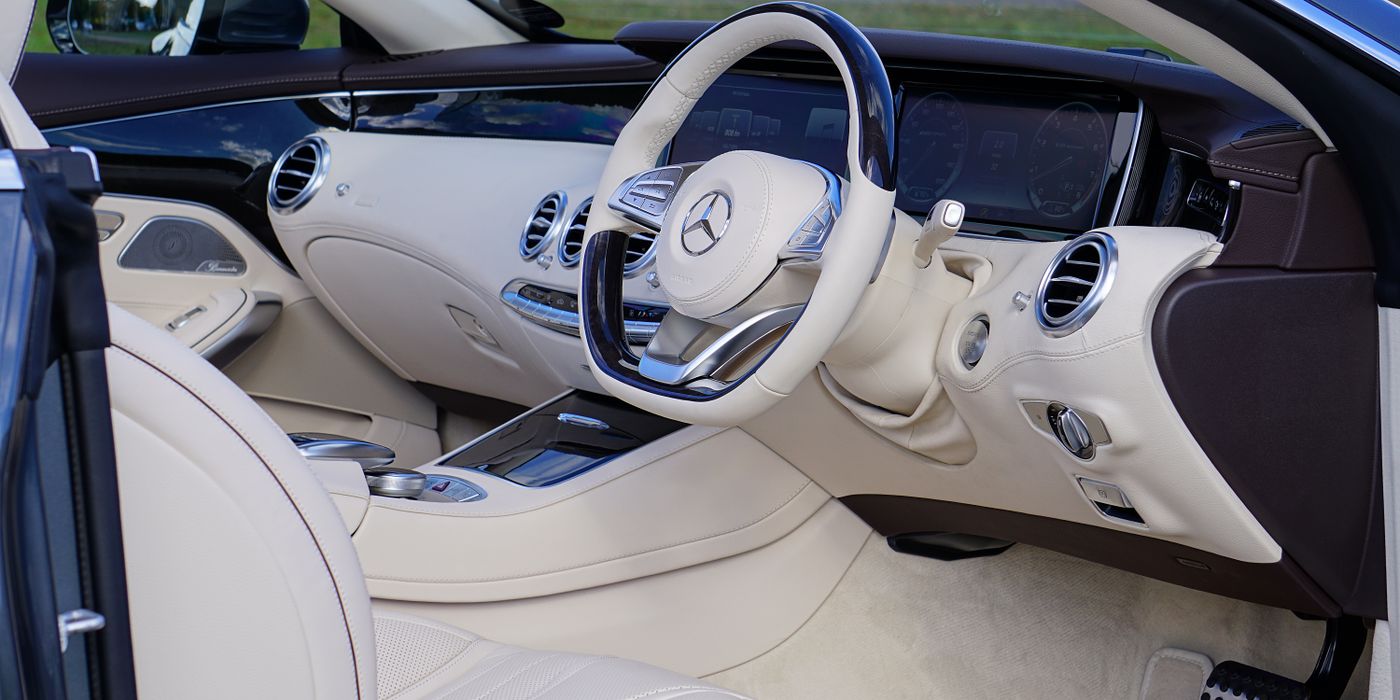
Sacramento spends a good chunk of July and August north of 100°F, and the inside of a parked car is meaningfully worse than the air outside it. Researchers at UC San Diego and Arizona State actually measured this across six vehicles: after one hour at 100°F ambient, a sun-parked dashboard reached 157°F, the steering wheel 127°F, the seats 123°F, and the cabin air 116°F.
The same cars parked in shade told a very different story — dashboard 118°F, wheel 107°F, seats 105°F. That's roughly a 39-degree difference on the dash from shade alone, which is the single most useful number in this article. (You'll see 180 to 200°F quoted online; we couldn't trace those to any actual study, so we'll stick with what was measured.)
What that heat is doing, chemically
Two processes run in parallel. The first is photodegradation: UV photons carry enough energy to break the carbon bonds in plastics directly, kicking off photo-oxidation that progressively embrittles the material. That's why an old dashboard goes from flexible to chalky and brittle rather than simply fading.
The second is more interesting, and it's the actual cracking mechanism. Flexible vinyl dashboards contain plasticizers — molecules that sit between the polymer chains and keep them sliding past each other. They aren't chemically bonded to the plastic. Heat and UV drive them to migrate to the surface and evaporate away, and as they leave, the vinyl stiffens until it cracks.
That haze on your windshield isn't cleaner residue
Here's the part most people never connect. Those plasticizers, once they migrate out and volatilize in a 157-degree cabin, have to go somewhere — and they condense on the coolest surface available, which is the inside of your windshield. The greasy film you keep wiping off your glass is, quite literally, your dashboard evaporating onto it. If you're fighting that haze constantly, the fix isn't better glass cleaner. It's getting heat and UV off the dash.
Leather ages two different ways
Worth separating, because the fixes differ. Fading is primarily a UV problem — light degrades the collagen fibers and the pigment. Cracking is primarily a heat-and-flex problem: heat drives moisture and oils out, the hide stiffens, and then it cracks where you repeatedly bend it getting in and out. Which is why the driver's bolster always goes first.
Nearly all modern automotive leather is pigmented — it carries an opaque polyurethane topcoat that provides most of its UV and stain resistance. Uncoated aniline and semi-aniline hides, found in some luxury interiors, fade noticeably faster and need more care. Either way, cleaning gently and keeping sun off the surface does more for longevity than anything else you can do.
What actually protects — and what just shines
Real UV protection in a product comes from two additive classes: UV absorbers, which soak up UV photons and dissipate the energy as heat, and hindered amine light stabilizers, which scavenge the free radicals that photo-oxidation produces. Used together they're genuinely synergistic, and they're in essentially every modern automotive coating. Most cheap high-gloss dressings contain neither. They're gloss, not protection.
On the old question of whether silicone dressings damage dashboards: that reputation comes from older formulations built on petroleum distillates and solvent-carried silicone oils, which genuinely could pull plasticizers out of vinyl — a mechanism entirely consistent with everything above. Modern water-based products are widely considered safer, though we couldn't find independent testing either way, so we won't name names. The useful rule is to read the label, skip anything with petroleum distillates or mineral seal oil near the top, and prefer matte water-based products with UV absorbers. Glossy dashboards also throw windshield glare and hold dust, which are reasons enough on their own.
The most effective interior protectant isn't a product. It's shade, a windshield sunshade, and UV-blocking window film — worth about 39 degrees on your dashboard.
If your interior has already gone chalky, hazy, or stiff, a proper interior detail with appropriate UV protection applied afterward will stop the clock — though it can't turn it back. Our interior service is built around exactly that, and we'd rather get to your dash before the cracks arrive than after.

The Nor-Cal Crew
Mobile detailing, ceramic coating & paint correction · Sacramento, California