
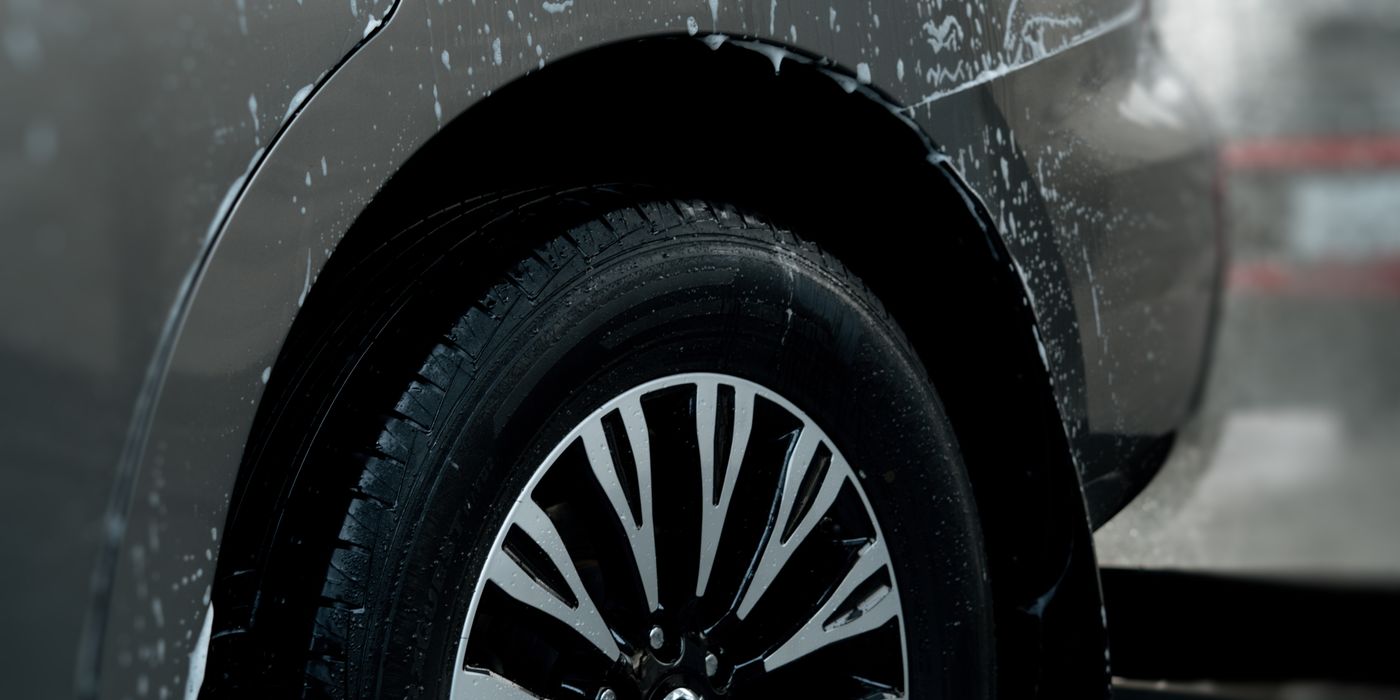
Most people treat brake dust as a cosmetic nuisance — the stuff that makes your wheels look dirty a week after you cleaned them. It's actually a corrosion problem with a deadline, and understanding why changes how you'd want your wheels cleaned.
What's actually coming off your brakes
With conventional cast-iron rotors, the particles emitted are roughly 94% iron and about 3% carbon, with trace elements making up the rest. Not dust in the household sense — metal. The particle sizes cluster around 200 nanometers and 1 micron, small enough to lodge into surface porosity that no brush will ever reach.
Temperature changes the character of it. Below about 300°C — call it 570°F — wear is mostly mechanical and throws off larger, irregular particles. Above that, oxidative wear takes over and the output shifts to far finer particles. Pad choice matters too: semi-metallic pads carry a lot of metal content and are the heaviest dust producers, while ceramic and low-metallic pads leave visibly less, and lighter-colored, residue.
Why it embeds instead of resting on top
Particles leave the brake hot and get thrown against the wheel face. Between that thermal energy and their sub-micron size, they wedge into microscopic pores and imperfections in the wheel's clear coat or paint rather than sitting on the surface. It's the same reason iron fallout embeds in horizontal paint panels.
Then the clock starts. Iron plus moisture plus oxygen equals oxidation, and the particle rusts in place — expanding as it corrodes, mechanically wedging its pore wider and undercutting the finish around it. That's how you get pitting and permanent staining on a wheel that gets washed regularly. (You'll read that brake heat imparts an electrostatic charge that makes dust cling; we found no scientific support for that, and the thermal embedding explanation covers it fine.)
Iron contamination is a clock, not a cosmetic issue. Left long enough it becomes damage that cleaning can't reverse.
Why the purple stuff is more than a gimmick
Iron removers are built around thioglycolic acid or its ammonium salt. The thiol group chelates iron and forms an iron-thioglycolate complex that happens to be intensely red-violet. That colour isn't a dye added for show — it's a genuine colorimetric indicator, the same chemistry used as a standard analytical test for iron. A deeper purple means more iron is coming off. It also only develops in near-neutral to alkaline conditions, which is exactly why these products aren't formulated as acids.
Mechanically, that chelation dissolves the embedded particle's grip on the finish so it rinses away — with no abrasion and nothing attacking the wheel itself. It reaches iron that a brush physically cannot. The only real downsides are the sulfurous smell and the fact that you can't let it dry on the surface.
Why we won't use acid wheel cleaners
The fast-acting acid cleaners are built on hydrofluoric acid or ammonium bifluoride. They work, and the risk depends entirely on what your wheels are made of. Bare or polished aluminium is the worst case — no clear coat, so the acid attacks raw metal and causes immediate, irreversible clouding. Anodized finishes stain permanently, because the anodic layer is porous and the acid gets in where it can't be rinsed back out. Clear-coated alloys, which is most modern OEM wheels, dull and etch with repeated use. Real chrome tolerates it best.
There are two problems with that. The first is that hydrofluoric acid is genuinely dangerous to people — it penetrates skin and causes deep tissue damage, often with delayed onset of pain. It is not a driveway DIY product. The second is that almost nobody can identify their wheel finish by looking at it, which is precisely why these cleaners cause so much damage.
So we skip them entirely. A pH-neutral wheel cleaner plus a dedicated iron remover achieves the same decontamination on any finish with essentially no risk. Acid buys speed, not results — and speed isn't what you're paying us for. If your wheels have started pitting or staining despite regular washing, that's embedded iron, and it's worth having decontaminated and then coated before the damage goes permanent.

The Nor-Cal Crew
Mobile detailing, ceramic coating & paint correction · Sacramento, California