
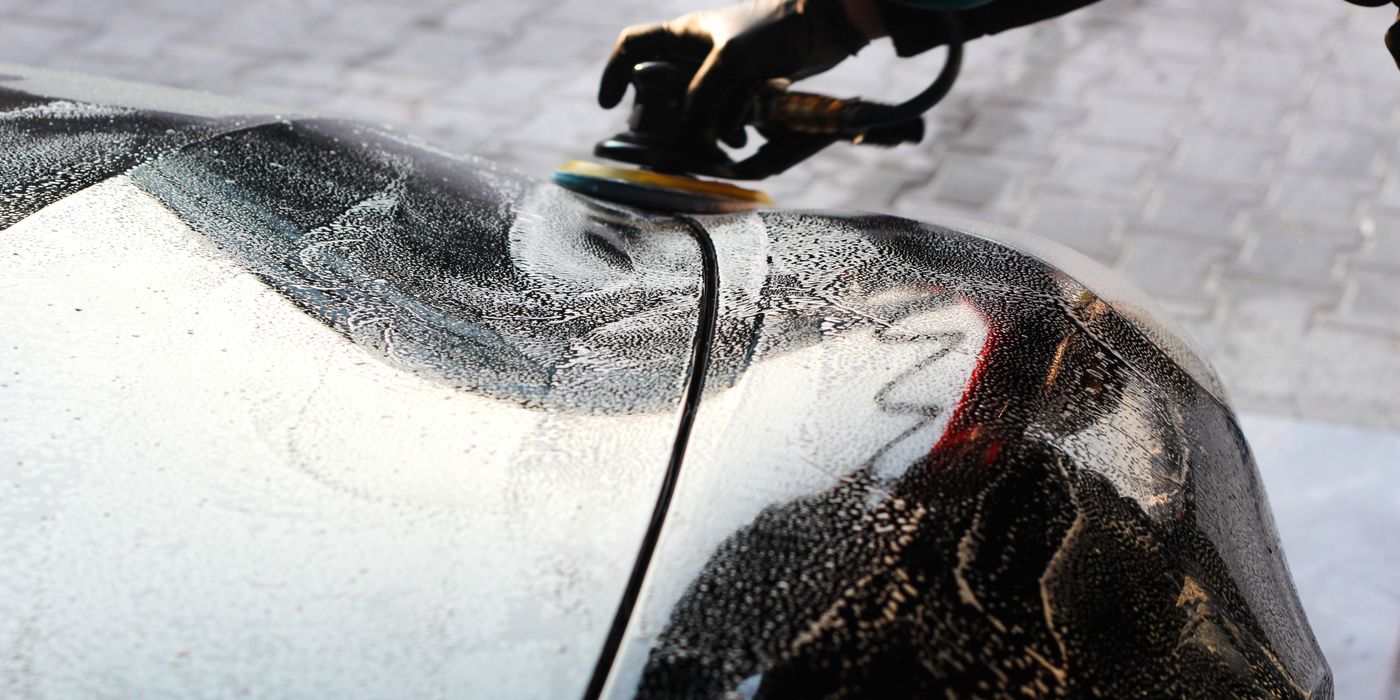
If you own something built before the mid-1980s and it wears its original finish, the paint on it works differently from every car in the lane next to you. Understanding how is the difference between a car that looks better and a car that has been quietly ruined by someone competent with modern equipment.
Two-stage versus single-stage, in one paragraph
A modern car is painted in two functional layers: a basecoat that carries the color and has essentially no gloss of its own, and a clear coat over it that provides the shine, the UV protection, and the sacrificial material you polish. When we correct a modern car, we are removing a few microns of clear. The color is never touched.
Single-stage paint combines both jobs in one layer. The pigment and the resin that carries the gloss are the same material, all the way through. There is no protective clear layer above the color, which means every polishing pass removes color.
How to tell which one you have
The test takes thirty seconds. Take a clean white or light microfiber, put a small amount of a mild polish on it, and work a hidden area gently by hand. A door jamb or the underside of a trunk lid is ideal.
- If the towel comes away with color on it, the paint is single-stage. You are looking at pigment that has come off the car.
- If the towel stays clean, there is clear coat over the color.
- Age is a strong hint but not proof. Clear coat became common through the 1980s, so anything from the 1970s and earlier is usually single-stage, anything from the 1990s onward is usually two-stage, and the 1980s are genuinely mixed.
- Repaints complicate it. A 1968 car resprayed in 1995 almost certainly has a modern basecoat and clear over it, and it is common to find one panel that differs from the rest.
That last case is the one that catches people. Test more than one panel on a car with any history, because a quarter panel that was redone after a parking lot incident does not behave like the door next to it.
Why oxidation looks so different on it
On a modern car, oxidation shows up as a dull, hazy clear coat with the color still intact underneath. On single-stage, the resin at the surface breaks down and leaves loose pigment behind, which is why a neglected red car from that era goes chalky pink and why touching it puts color on your hand.
Red and other organic pigments fade fastest, which is why the classic image of a sun-baked older car is almost always a faded red one. In the Sacramento Valley this is accelerated badly by UV exposure, and a car that lives under a carport is in a genuinely different condition from an identical car parked in the open.
What correct polishing looks like on it
The good news is that oxidation on single-stage is often shallow, and beneath the chalky surface the paint can still be rich. The work is about removing as little as possible to get there.
- Measure first. A paint depth gauge tells us what we have to work with, and on an original car those readings are the deciding factor in what is possible. Original finishes are frequently thinner than a modern factory job, and areas that have been polished repeatedly over fifty years can be alarmingly thin.
- Start with the least aggressive combination that works, test it in a small area, and only step up if the test says to. This is standard practice everywhere and it is non-negotiable here.
- Expect the pads and towels to load with color. That is normal and it is also the ongoing measurement of what you are removing. Change pads often, because a pad saturated with pigment stops cutting cleanly.
- Stay off edges, body lines, and crowns. Paint is always thinnest where the panel curves, and on a car with fifty years of hand-waxing those areas have already been worked.
- Slow the machine down and keep heat out of the panel. Older paint is more heat-sensitive than a modern clear.
On a modern car, an aggressive pass costs you a small amount of clear coat. On original single-stage, an aggressive pass costs you the car's original paint, and there is no version of putting that back.
The originality question comes before the shine question
This is a conversation we have before touching a collector car, and it matters more than any technical detail above. In many corners of the collector market, original paint carries real value, and a car described as having its original finish is worth more than the same car resprayed to a higher standard.
That means the right answer for a survivor car is sometimes to do far less than we could. A gentle cleanup, a careful protective step, and leaving the patina alone can preserve more value than making it gleam. For a driver that has already been repainted, none of that applies and we can work normally.
So we ask what the car is to you, and what you intend to do with it, before we ask what you want it to look like. Those are different questions and they lead to different work.
Protecting it afterward
Single-stage benefits enormously from protection, because it has no clear layer taking the UV hit. Traditional carnauba is what these cars have always used and it looks right on them, but in this climate it is gone in a matter of weeks and it needs reapplying constantly.
A modern sealant or a ceramic coating works on single-stage and lasts vastly longer. Some owners of concours-level original cars prefer to stay with wax for authenticity, and that is a legitimate choice as long as it comes with the reapplication schedule to back it up. For a car that gets driven and stored outdoors in the Valley, we would rather see it coated.
If you have something original and you are not sure what is under the oxidation, we will test a small area, take depth readings, and show you the result before agreeing to do the whole car. On these, the assessment is most of the value.

The Nor-Cal Crew
Mobile detailing, ceramic coating & paint correction · Sacramento, California