
Yellowed headlights read as cosmetic — the thing that makes a ten-year-old car look its age. The testing says otherwise. When AAA measured a pair of eleven-year-old sedans against new OEM assemblies, the deteriorated low beams produced just 22% of the light output. That's roughly an 80% reduction, on the equipment you rely on at night, when about half of all crashes happen.
For scale: safety testers generally reckon a driver needs 300 to 350 feet to see, react, and brake at 60 mph. Losing four-fifths of your illumination is not a styling problem.
Why they yellow in the first place
Modern lenses are polycarbonate, not glass — the industry switched decades ago for impact resistance and the freedom to mold complex shapes. Polycarbonate on its own degrades badly under UV, so manufacturers apply a factory hardcoat, typically a UV-cured polyurethane carrying UV absorbers and light stabilizers.
That hardcoat is a consumable. Sun, moisture, car wash chemicals, and road grit gradually deplete and erode it, and once bare polycarbonate is exposed, photo-oxidation begins: UV cleaves the polymer's bonds and oxidation of the resulting compounds produces the yellow-brown discoloration you're looking at. AAA found deterioration can start as early as three years, and is common by five.
First, check that it's actually the outside
This matters, because restoration only addresses the outer surface and we'd rather tell you that before taking your money. Exterior oxidation looks yellow or brown, is often patchy or streaked, and you can feel the roughness with a fingertip. Interior condensation looks like a uniform haze across the entire lens, with no color shift and a perfectly smooth outer surface.
The test takes twenty minutes: run the headlights and watch. Fog that clears as they warm is condensation from a failed vent or seal — that's a housing problem, and no amount of sanding the outside will fix it. Fog that stays, or standing water in the assembly, needs inspection rather than restoration.
What a real restoration involves
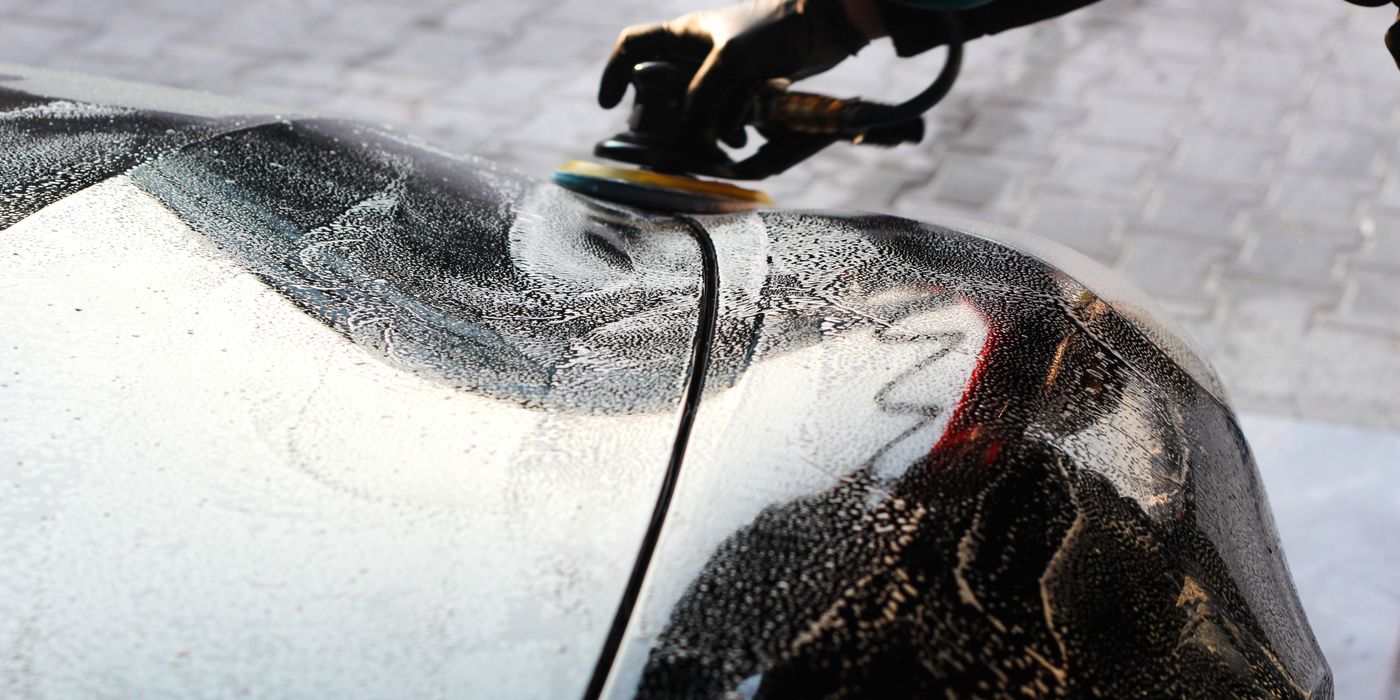
Wet sanding, progressively finer, kept genuinely wet throughout — dry sanding polycarbonate generates enough heat to melt and gall the surface, leaving damage that won't polish out. We alternate stroke direction ninety degrees with each grit, which is the only reliable way to see that the previous grit's scratches are fully gone. Then machine polishing restores optical clarity.
The step that separates a lasting job from a disappointing one is the last one: re-applying UV protection. The factory hardcoat has just been sanded entirely away, which means the lens is now more UV-vulnerable than it was when you started. Skip the sealing step and you've bought a few good months.
Any abrasive — toothpaste included — removes what's left of the hardcoat. If nothing UV-blocking goes back on, the lens yellows again faster than before.
That's not us disparaging DIY kits, incidentally. Consumer Reports tested inexpensive kits and found even the weaker performers meaningfully improved light output on weathered lenses. But many of those lenses began re-hazing within a year — which tells you the abrasion worked and the protection didn't last.
The honest limitation
Here's the part most restoration articles leave out. In AAA's testing, professional and DIY restoration both recovered roughly 70% of new-headlight performance — a substantial improvement over 22%. But AAA also found that both methods produced more glare than DOT criteria allow. Restoration meaningfully improves what you can see; it doesn't perfectly restore the optical control that keeps light out of oncoming drivers' eyes.
So the honest hierarchy is: OEM replacement performs best, aftermarket assemblies come next but are more glare-prone, and restoration lands around 70% for a small fraction of the cost. For most vehicles that trade is well worth making — we just think you should know what you're buying. It's one of our most cost-effective add-ons, and it transforms how the front of an older car reads.

The Nor-Cal Crew
Mobile detailing, ceramic coating & paint correction · Sacramento, California