
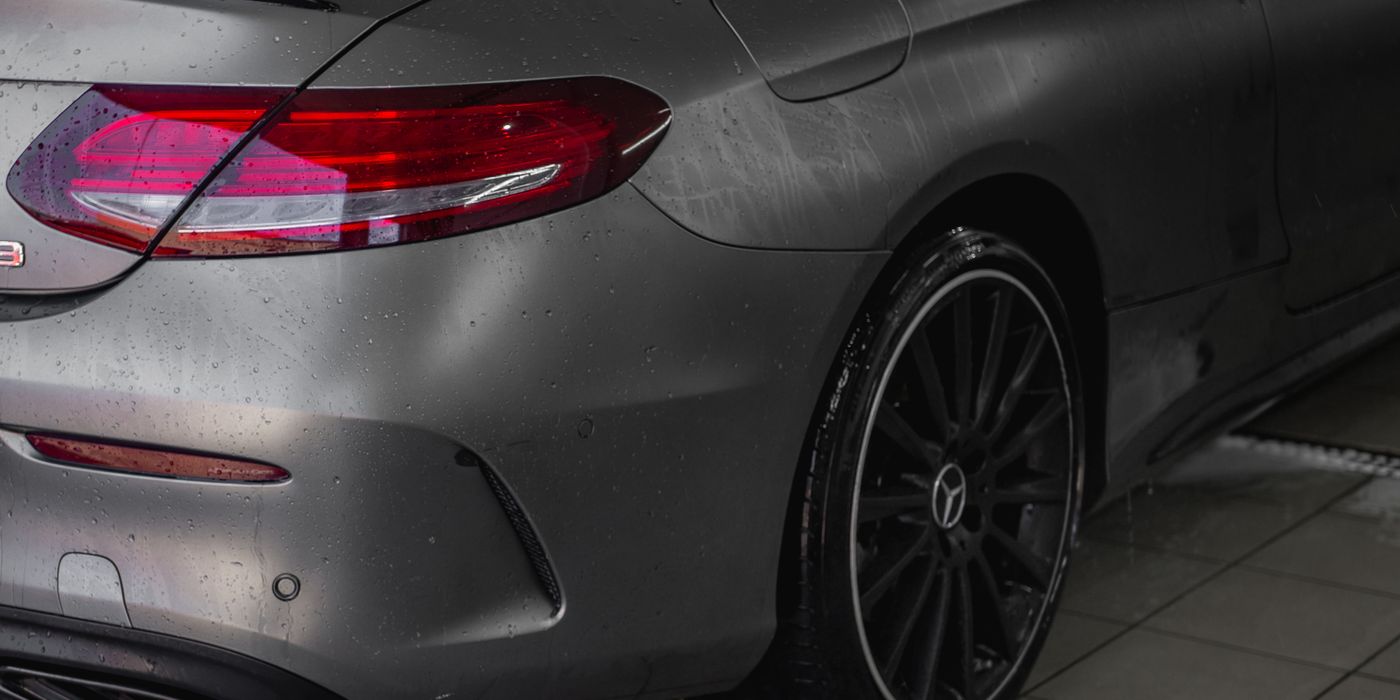
Matte and satin finishes have gone from exotic special order to something you see in a Roseville parking lot, both as factory paint and as vinyl wraps. They also come with a care regime that inverts most of what people know, and the failure mode is permanent.
Why it looks matte
Gloss is a flat, smooth surface reflecting light in one direction. Matte is the same paint chemistry with a deliberately textured microscopic surface, achieved with flatting agents in the clear coat, that scatters incoming light in every direction. Your eye reads that scatter as flat.
That is the entire mechanism, and it explains every rule that follows. Anything that smooths the texture creates a shiny spot, and a shiny spot on a matte panel is more visible than a scratch on a gloss panel.
The things that permanently ruin it
- Polishing or compounding. Machine polishing flattens the texture by design. One pass makes a glossy patch that cannot be reversed, because you cannot put microscopic roughness back. Refinishing the panel is the only fix.
- Wax and sealants. Traditional waxes and glossy sealants fill the texture and add shine. Even a light application changes the appearance, and carnauba on matte is the classic mistake.
- Rubbing a spot. This is how most matte finishes get damaged, and it is completely intuitive behavior. Someone sees a bird dropping, grabs a towel, and rubs. The rubbing burnishes the texture into gloss.
- Automatic washes. Brushes burnish the surface. Touchless washes rely on high-pH chemistry that can stain matte finishes unevenly. Neither belongs anywhere near a matte panel.
- Ordinary car soap with gloss enhancers in it. Read the label. Many mainstream soaps contain gloss agents that build up on a matte surface and leave it patchy.
On gloss paint, a mistake makes it duller. On matte paint, a mistake makes it shinier, and only one of those two can be corrected.
How to wash one correctly
The method is not difficult, it is just specific. Use a soap made for matte finishes with no gloss enhancers and no wax content. Two buckets with grit guards, or a rinseless method, and a soft clean mitt. Work top down and use straight-line motions rather than circles, because circular motion is what creates a burnished swirl on a textured surface.
Dry with a plush microfiber using a blotting or dragging motion rather than a circular wipe, or better, use a blower and do not touch the surface at all. Air drying is not an option in Sacramento, because hard water spots on matte are a genuine problem: the mineral deposit sits in the texture and needs a matte-safe spot remover rather than the acid approach used on gloss.
Spot cleaning without wrecking it
Bird droppings, bug splatter, and sap need to come off fast, and the technique is the opposite of what you would do on gloss. Saturate the area with a matte-safe detail spray and let it soften the contamination completely. Then lift it away with a clean microfiber using no pressure at all, blotting rather than wiping. If it does not release, saturate again and wait longer.
Never dry-wipe anything off a matte finish. Never apply pressure. The material you are trying to remove is abrasive and the surface you are protecting is texture.
Matte-specific coatings exist and they are worth it
This is the one place where the matte owner gets a genuinely better deal than the gloss owner. Coatings formulated for matte finishes bond to the surface without filling the texture, so they add protection and hydrophobic behavior with no change in appearance.
The value is higher here than on gloss for a straightforward reason: on a gloss car, a mistake during washing means correctable swirls. On a matte car, it means an uncorrectable shiny patch. A coating that reduces how much contact the surface needs is directly reducing the risk of the one failure you cannot fix. Verify the product is specified for matte, because a standard coating adds gloss.
Wrapped versus factory matte
Matte vinyl wrap follows the same rules with two additions. Edges and seams need care, because pressure and hot water lift them, and a lifted edge lets water and dirt underneath. And a wrap has a finite life, generally a handful of years in Valley sun, after which it comes off and is replaced. Factory matte paint is a permanent finish and a damaged panel is a refinishing job.
The practical difference is what a mistake costs. On a wrap, a burnished patch is a panel of vinyl. On factory matte, it is a repaint that has to match the surrounding panels, and matching a matte finish is harder than matching gloss.
If you own one, tell us it is matte when you book rather than when we arrive, and tell us whether it is paint or wrap. We use different products and a different process for these, and it is not a job to hand to whoever is cheapest that week.

The Nor-Cal Crew
Mobile detailing, ceramic coating & paint correction · Sacramento, California